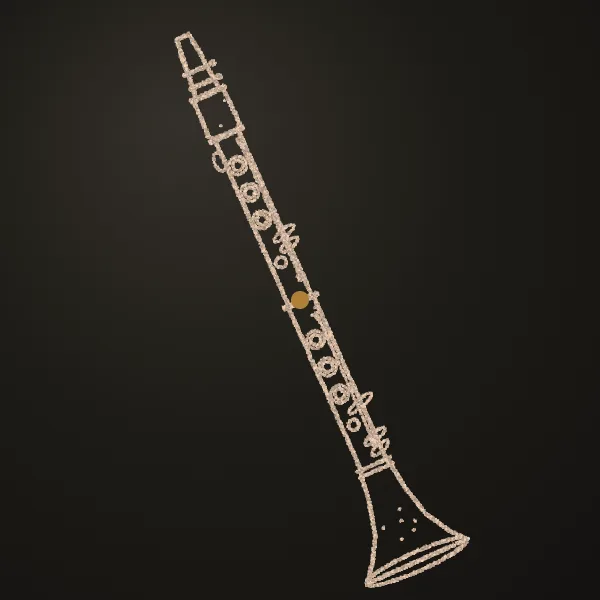
A single cane reed is clamped to the mouthpiece. The player's breath pushes it shut, the pressure in the tube pushes it open, and it beats against the mouthpiece at the frequency of the note, opening and closing a narrow slot hundreds of times a second.
Resonator Stopped pipe
A cylinder about 66 cm long and 15 mm wide, effectively closed at the reed end. A pipe closed at one end only resonates at odd multiples of its lowest note (1, 3, 5, 7…), so the low register has hardly any 2nd and 4th harmonic: the dark, woody chalumeau sound.
Body Open air
The open tone holes and the small bell radiate the sound. Above about 1.5 kHz the row of open holes lets the even harmonics back in, so the high notes sound brighter.
Where it comes from
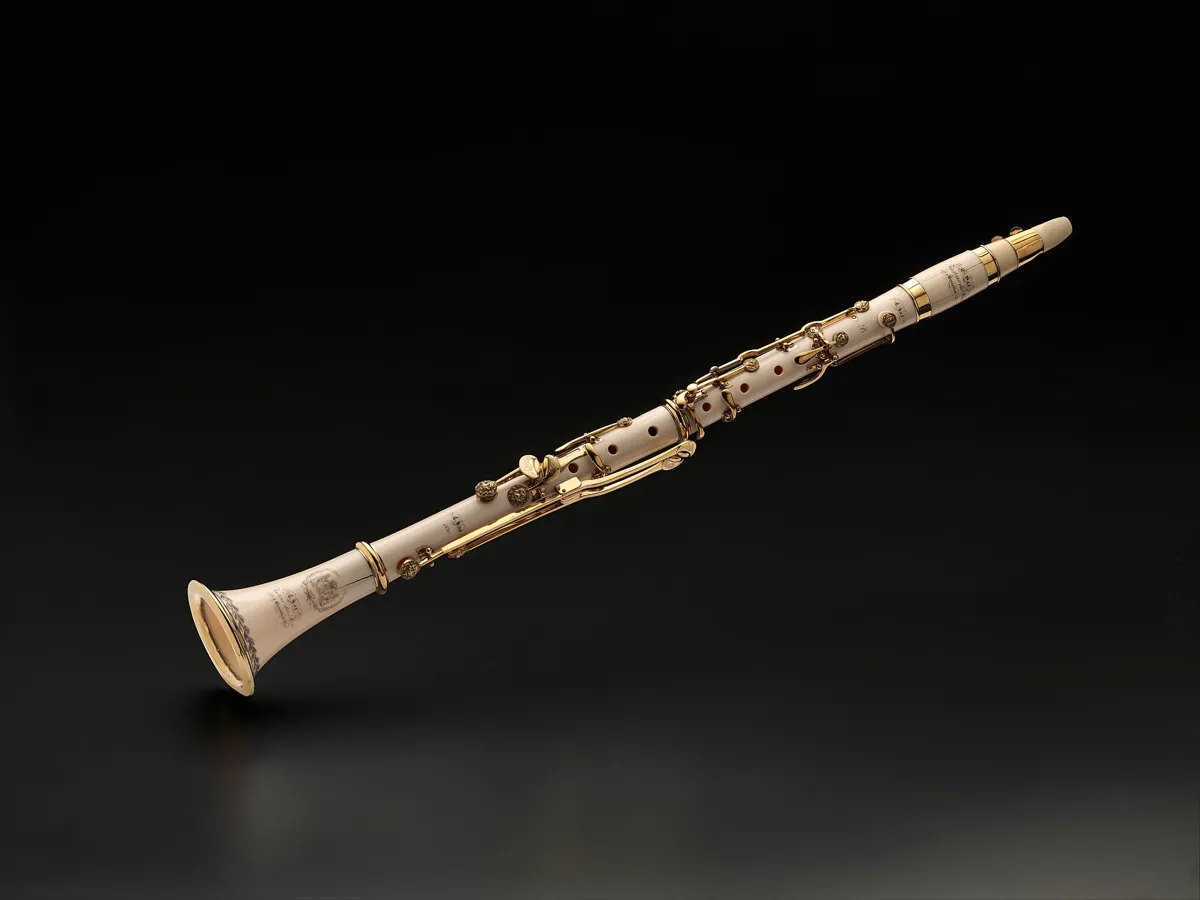
The clarinet grew out of the chalumeau, a simple single-reed pipe, in Nuremberg around 1700; the Denner family of instrument makers added the register key that opens the upper notes. Mozart's Clarinet Concerto and Clarinet Quintet were written for his friend Anton Stadler, who played a basset clarinet that reached lower than the ordinary instrument.
Length (B♭)
~66 cm
Bore
~15 mm
Overblows
a twelfth
Reed
one, cane
Photo: The Metropolitan Museum of Art (object: Charles-Joseph Sax), Wikimedia Commons, CC0.
Worth knowing
The clarinet overblows a twelfth, not an octave, so the same finger pattern gives different note names in different registers.
Its lowest register is still called the chalumeau, after the instrument it came from.
Most professional clarinets are made of African blackwood, a slow-growing tree protected under CITES.
Often said
“J. C. Denner invented the clarinet in 1690.”
No evidence for 1690. A 1730 account places the invention after 1698, and whether Johann Christoph Denner or his son Jacob added the register key is still argued.