← Whyarium no. 43 Excite / Resonate
Instruments · Winds

Flute

No reed and no vibrating solid at all: a jet of breath flips in and out across a hole, and a tube of air answers.

Patch
Air jet → Open pipe → Open air
Class
H–S 421.121.12-71 · side-blown flute with keys
From
Munich (the Boehm flute)
When
1832 and 1847
01

Exciter

what pushes

Out
02

Resonator

what rings
In
Out
03

Body

what moves the air

In
Out
04

Sand plate

where the still lines are
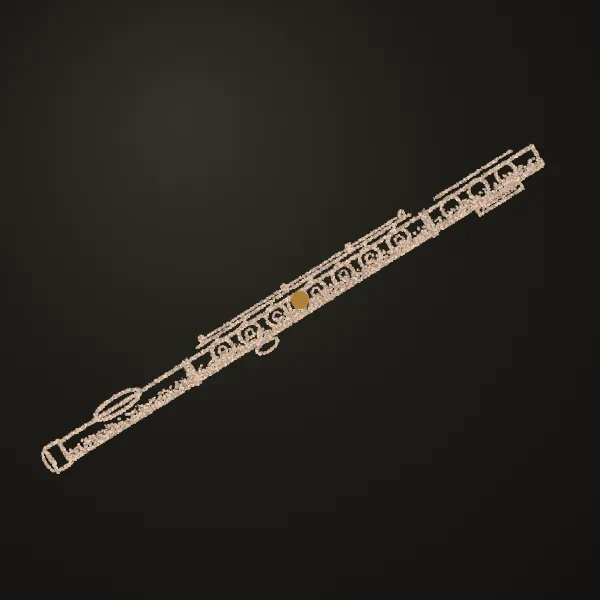
Flute drawn in sand on a dark metal plate
Note –– HzFigure –

In
Patch

Flute

No reed and no vibrating solid at all: a jet of breath flips in and out across a hole, and a tube of air answers.

Exciter Air jet

The player blows a thin jet across the embouchure hole, aimed at its far edge. The jet is unstable: it flips into the tube and out again, and the air in the tube, pushing back, tells it when to flip. The jet works like a valve that opens and closes at the note's frequency.

Resonator Open pipe

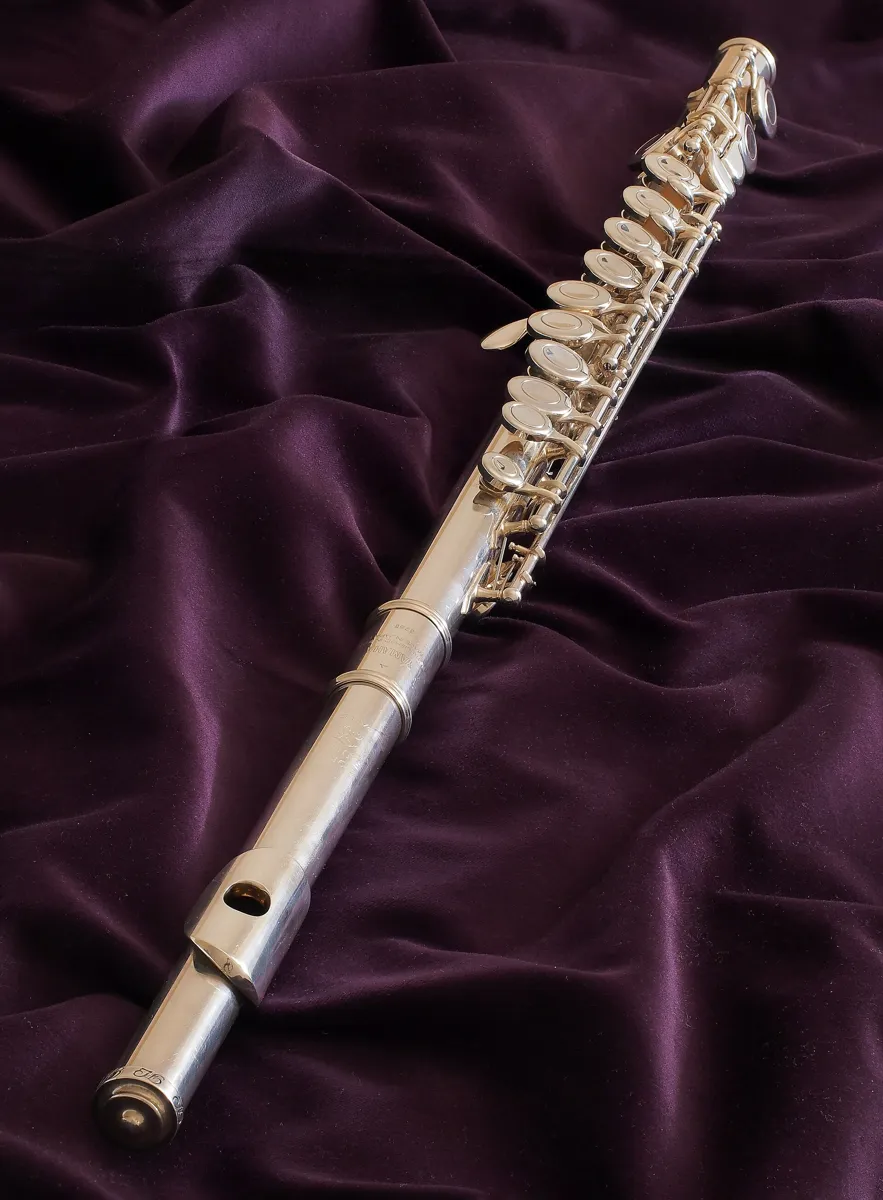
A tube about 67 cm long and 19 mm wide, open at both ends. An open pipe supports every harmonic, so overblowing jumps a whole octave. Opening the keys shortens the vibrating column. In the top octave the tone is close to a pure sine.

Body Open air

There is no separate body. The open end and the open tone holes radiate the sound straight into the room.

Where it comes from

Flutes are the oldest instruments known: bone and mammoth-ivory flutes from caves in the Swabian Jura in Germany are about 40,000 years old. The modern flute belongs to Theobald Boehm, a Munich goldsmith and flute player, who redesigned it in 1832 with a ring-key mechanism and again in 1847 as the cylindrical metal tube with large tone holes that orchestras use today.
Length~67 cm
Bore~19 mm
RangeC4 to about C7
Overblowsan octave
Photograph: Flute
Photo: Petar Milošević, Wikimedia Commons, CC BY-SA 4.0.

Worth knowing

  1. A silver flute is still a woodwind: instruments are classified by how they make sound, not by what they are made of.
  2. Because both ends are open, overblowing a flute jumps an octave; the clarinet, closed at the reed, jumps a twelfth.
  3. Boehm was also an engineer who worked on iron production, and the flute's key mechanism shows it.
Often said

“The Divje Babe bone from Slovenia, about 50,000 years old, is a Neanderthal flute.”

Disputed. Many researchers think its holes were bitten by a carnivore.