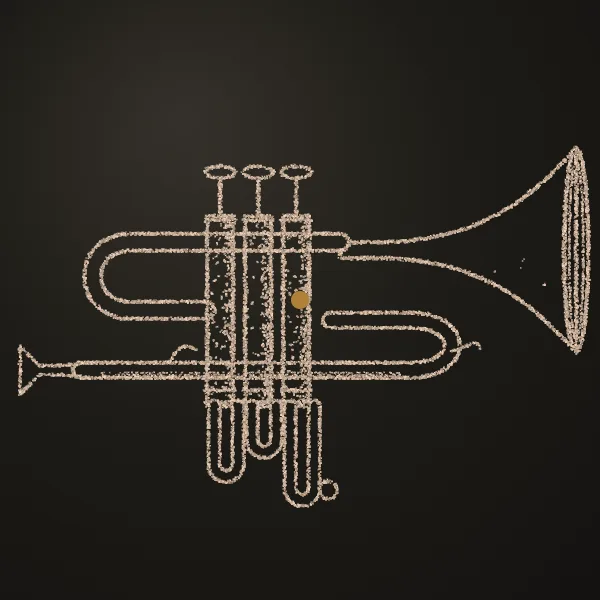
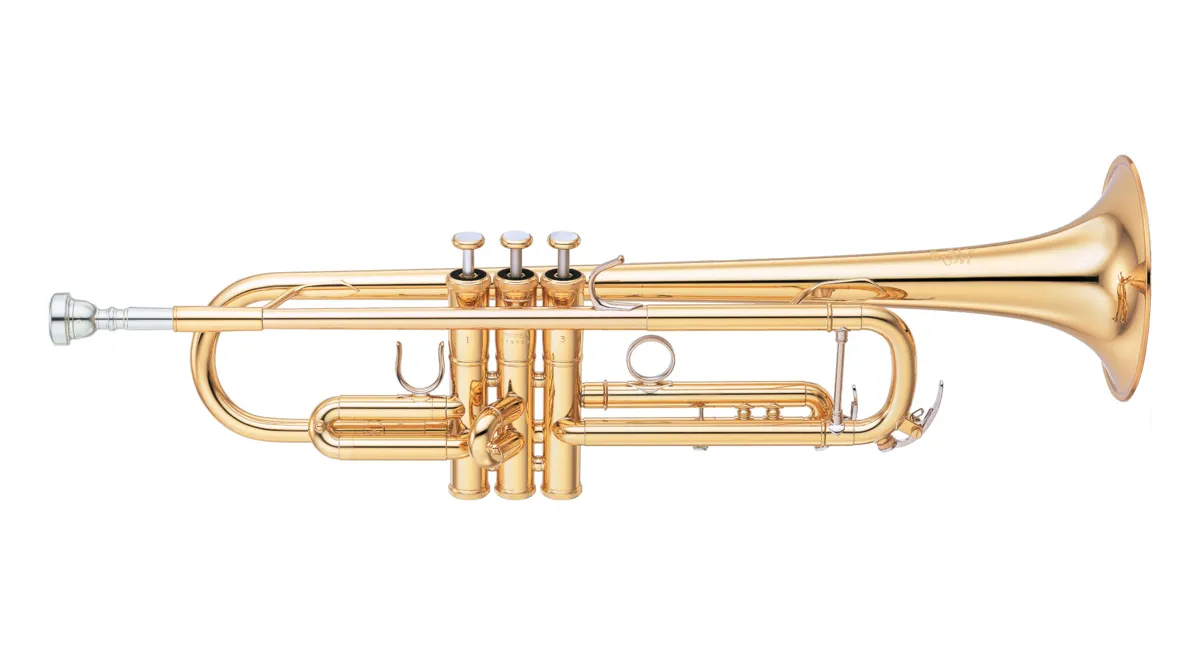
The lips, pressed into a cup mouthpiece, buzz like a double reed: air forces them apart, they snap shut, the tube pushes back. Tighter lips and faster air make the buzz lock onto a higher resonance of the tube.
Resonator Brass tube
About 1.48 m of tubing, mostly cylindrical, 11.7 mm across. A plain cylinder closed at the lips would give only odd harmonics. The flaring bell and the mouthpiece bend those resonances until they fall close to 2, 3, 4, 5, 6 and 8 times a missing low note: a full harmonic series to play on.
Body Flared bell
The bell, about 12 cm across, lets the high partials out into the room and reflects the low ones back to keep the tube ringing. That is why a trumpet sounds brighter the louder it is played.
Where it comes from
Trumpets are ancient: two were found in Tutankhamun's tomb. For most of history a trumpet could only play the notes of one harmonic series, which is why Baroque trumpeters climbed to the very top of the series, where the harmonics are close enough together to make scales. Valves, which switch in extra lengths of tube, were invented in Silesia and Prussia around 1814–1818 by Heinrich Stölzel and Friedrich Blühmel.
Tutankhamun's two trumpets, one silver and one bronze, were played on a BBC radio broadcast from Cairo on 16 April 1939.
Haydn's Trumpet Concerto (1796) was written for Anton Weidinger's keyed trumpet, before valves existed.
Valves 1 and 3 pressed together play sharp, so trumpets have movable slides on those valve tubes for the player to pull out.
Often said
“Playing Tutankhamun's trumpets brings war.”
Legend, tied to the 1939 broadcast and the war that followed. The story that the silver trumpet shattered during the broadcast also rests mainly on one later account.