A fingertip or nail pulls the string aside and lets go. The string starts as a triangle with its corner at the plucking point, and that shape decides which harmonics are there: any harmonic with a node at that point is missing. Pluck at one fifth of the length and the 5th, 10th and 15th are gone. Near the bridge the tone is bright and nasal, over the soundhole it is round.
Resonator String
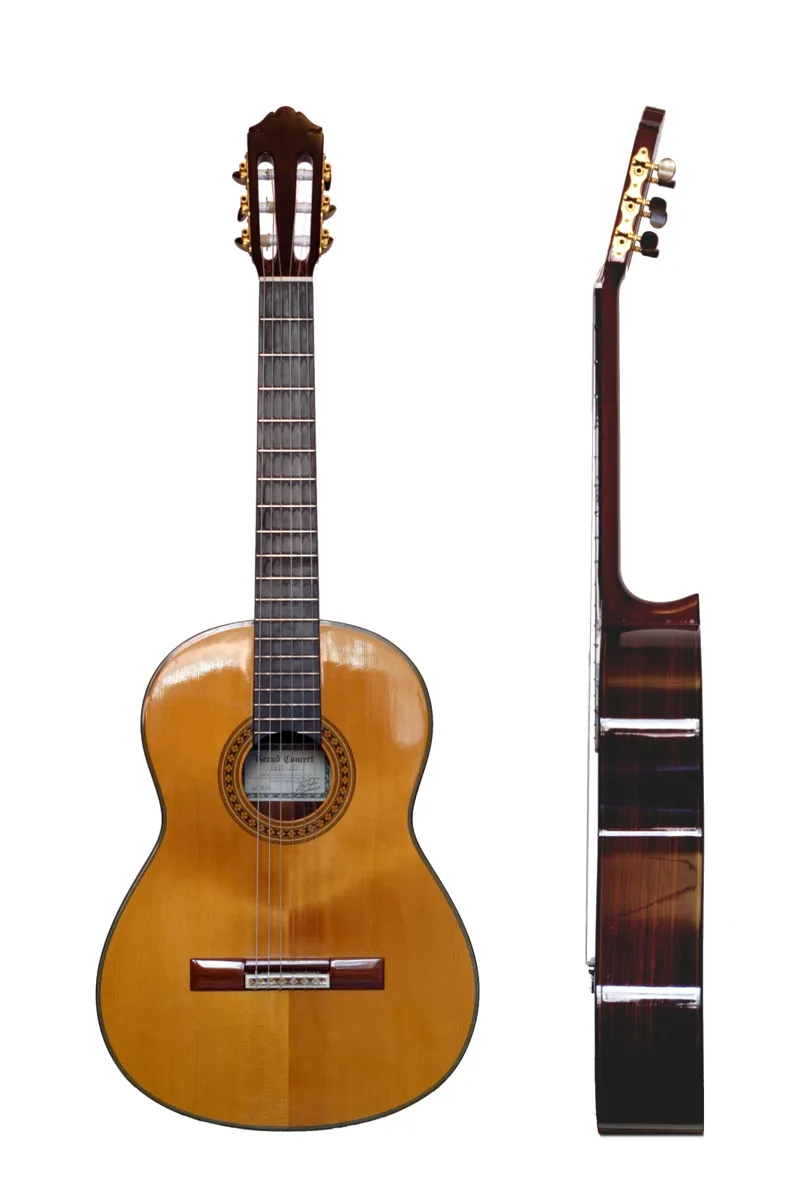
Six strings over a 650 mm scale. The frets follow the twelfth root of two: each one shortens the string by about 5.6 %, and the twelfth fret sits exactly halfway, 325 mm from the nut.
Body Guitar box
A plucked string is quiet; the top plate does the work. The air in the box breathes through the hole near 90–100 Hz and the top's first mode sits near 200 Hz, which together give the guitar its low warmth. The sound then dies away: nothing keeps feeding it.
Where it comes from
Spain had guitars with four and five courses of paired strings in the 16th and 17th centuries; six single strings became normal by about the 1790s. The guitar as concert players know it was shaped in Almería and Seville in the 1850s and 1860s by Antonio de Torres, who made the body bigger and braced the thin top with a fan of struts. Gut strings gave way to nylon after the Second World War.
Torres is said to have built a guitar with a papier-mâché back and sides in 1862 to show that the spruce top makes the sound.
Nylon strings were developed after 1945 by Albert Augustine in New York, with DuPont nylon, and taken up by Andrés Segovia.
Guitar music is written an octave higher than it sounds, on a treble clef.
Often said
“The guitar descends directly from the Arab oud.”
Disputed. The oud is fretless with a bowl-shaped back; the guitar's flat back and waisted body point to the vihuela and the gittern, and the family tree is still argued over.