← Whyarium no. 43 Excite / Resonate
Instruments · Strings

Pedal harp

Forty-seven strings rising straight out of the soundboard, and seven pedals at the harpist's feet that retune every string of the same name at once.

Patch
Pluck → String → Soundboard
Class
H–S 322.22 · frame harp with pedal action
From
Mesopotamia and Egypt; pedals in Bavaria and Paris
When
harps c. 3000 BC; double action 1810
01

Exciter

what pushes

Out
02

Resonator

what rings
In
Out
03

Body

what moves the air

In
Out
04

Sand plate

where the still lines are
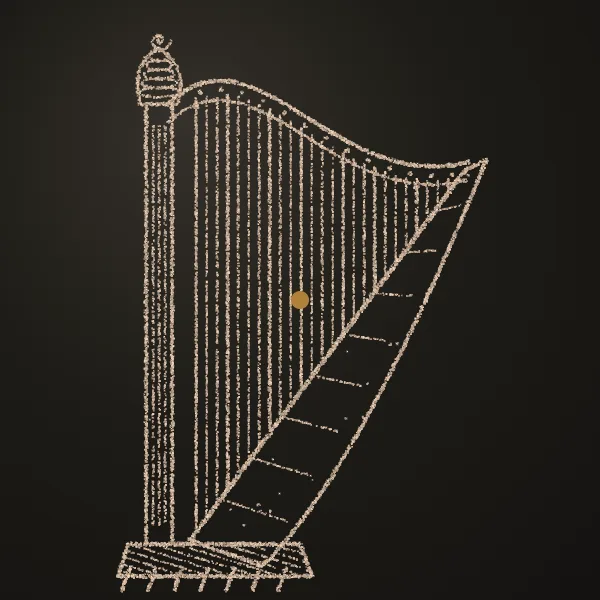
Pedal harp drawn in sand on a dark metal plate
Note –– HzFigure –

In
Patch

Pedal harp

Forty-seven strings rising straight out of the soundboard, and seven pedals at the harpist's feet that retune every string of the same name at once.

Exciter Pluck

Harpists pluck with the pads of four fingers of each hand (never the little fingers), usually near the middle of the string. Plucking at the middle cancels every even harmonic, which is why the harp sounds so round. Touching a string at its midpoint while plucking gives a harmonic an octave higher.

Resonator String

Strings of gut, nylon and wound wire, from about C1 to G7. The C strings are dyed red and the F strings dark, so the player can find their way along a wall of strings.

Body Soundboard

The strings pull straight up from the soundboard, so the board is bent by their tension and drives the air directly. The soundbox behind it widens towards the bottom to give the long bass strings a bigger board.

Where it comes from

Harps are among the oldest stringed instruments: arched harps appear in Sumerian and Egyptian art around 3000 BC, and harps were found in the Royal Tombs of Ur. Pedals came in the 18th century; the single-action harp could raise each string by a semitone. Sébastien Érard's double action of 1810 lets each pedal raise its strings by one or two semitones, so the harp can play in every key.
Strings47
Pedals7
Height~1.85 m
RangeC1 to G7
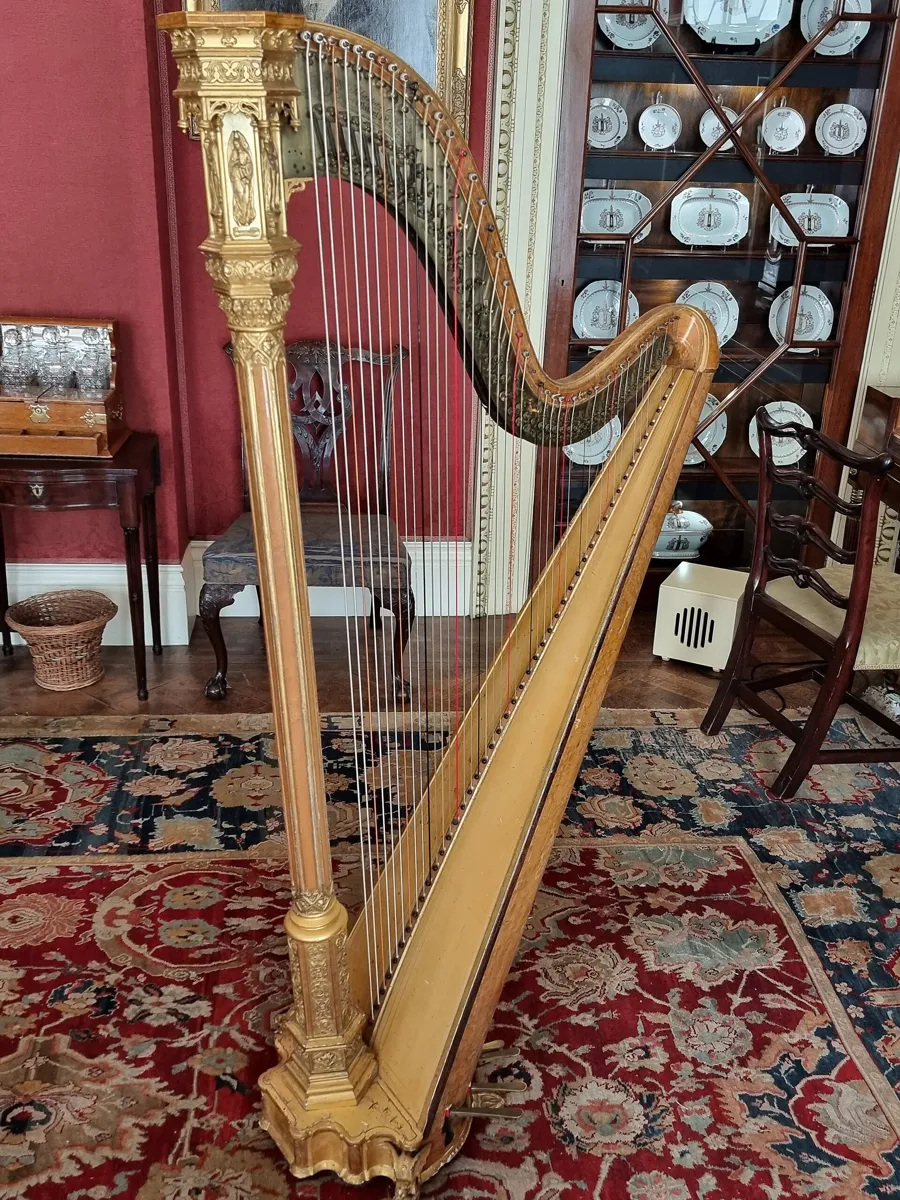
Photograph: Pedal harp
Photo: Richard Avery, Wikimedia Commons, CC BY-SA 4.0.

Worth knowing

  1. Some notes have two names on different strings (B♯ and C♮), and harpists use that to make one note ring on two strings at once.
  2. The harp is the national emblem of Ireland, on its coins and passports; the model is the medieval "Brian Boru" harp at Trinity College Dublin.
  3. A concert harp stands about 1.8–1.9 m tall and weighs around 35–40 kg.
Often said

“Érard invented the double-action pedal harp.”

Contested. Charles Gröll filed a patent for a double action in 1807, three years before Érard's 1810 patent.