A string that is dragged, slips and is dragged again, hundreds of times a second, and a hollow box of spruce and maple that turns a whisper into a sound that fills a hall.
Patch
Bow → String → Violin box
Class
H–S 321.322-71 · bowed box lute
From
Cremona and Brescia, northern Italy
When
c. 1520s–1560s
01
Exciter
what pushes
Out
02
Resonator
what rings
In
Out
03
Body
what moves the air
In
Out
04
Sand plate
where the still lines are
Note –– HzFigure –
In
Patch
Violin
A string that is dragged, slips and is dragged again, hundreds of times a second, and a hollow box of spruce and maple that turns a whisper into a sound that fills a hall.
Rosin makes the horsehair sticky. The bow grips the string and drags it sideways until the string snaps back and slips, then grips again: stick–slip. The string does not swing as a smooth arc but as two straight halves joined by a sharp corner that races round it once per cycle (Helmholtz motion), so every harmonic is present.
Resonator String
Four strings, G3 D4 A4 E5, about 328 mm long between the nut and the bridge. A finger on the fingerboard shortens one and raises its note.
Body Violin box
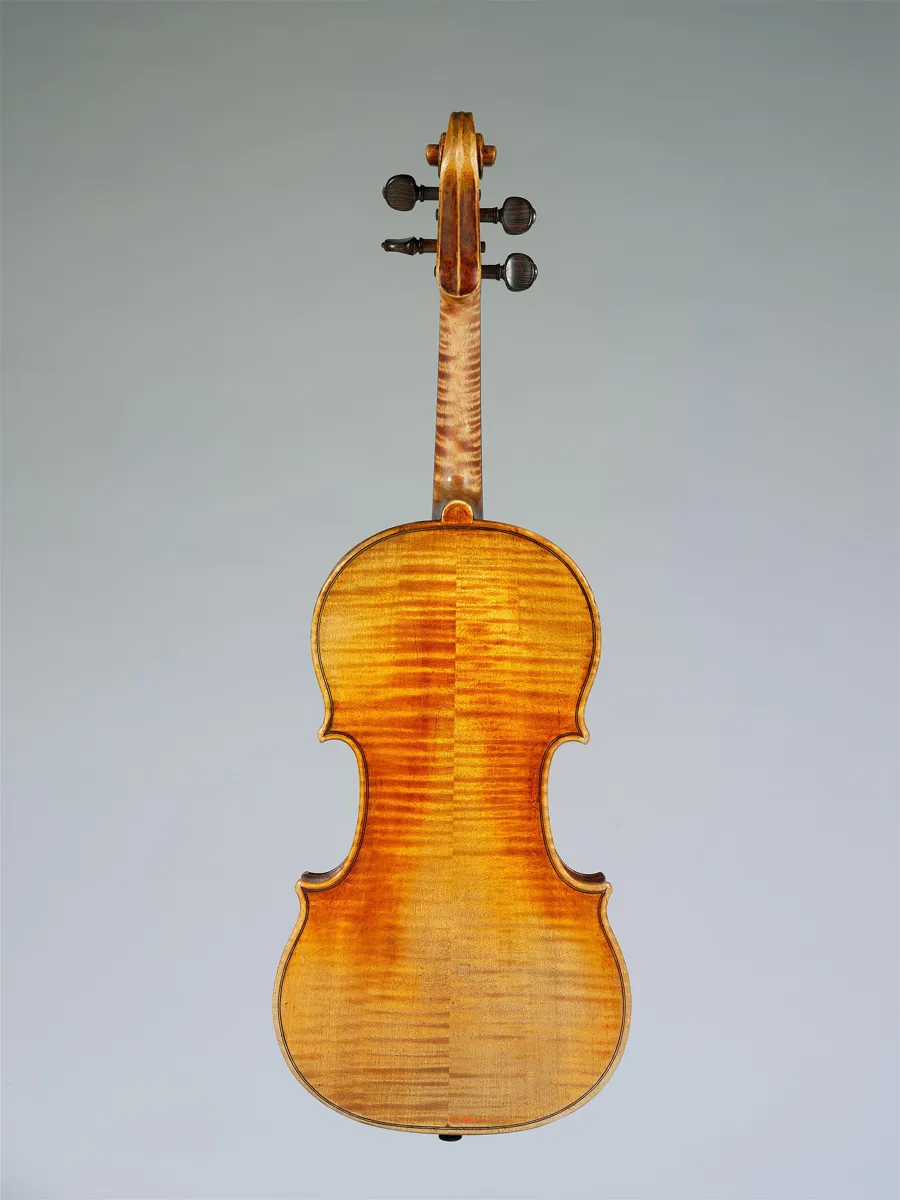
The bridge rocks on the top plate. A small spruce soundpost, wedged but not glued between top and back, lets the plate move asymmetrically. The air in the box breathes through the f-holes near 280 Hz, the wood rings around 450–550 Hz, and a "bridge hill" near 2–3 kHz gives the violin its edge.
Where it comes from
The four-string violin appears in northern Italy in the middle of the 16th century, out of earlier bowed instruments such as the rebec and the lira da braccio. Andrea Amati of Cremona is the earliest maker whose violins survive; Stradivari and Guarneri "del Gesù" worked in the same town a century and a half later. The modern bow, its stick curved in towards the hair, was settled by François Tourte in Paris around the 1780s.
Body length
356 mm
String length
~328 mm
Open strings
G3 · D4 · A4 · E5
Range
G3 to about A7
Photo: The Metropolitan Museum of Art (object: Antonio Stradivari, 1711), Wikimedia Commons, CC0.
Worth knowing
The "Charles IX" violin by Andrea Amati (c. 1564), now in the Ashmolean Museum, Oxford, is usually called the oldest surviving dated violin. It belonged to a set made for the French court.
In double-blind tests published in 2012 and 2014, soloists could not reliably tell Stradivari and Guarneri violins from good new ones, and often preferred the new ones.
The "Messiah" Stradivarius of 1716, also in the Ashmolean, is in near-original condition because it has hardly ever been played.
Often said
“Stradivari had a lost secret (a varnish, a wood treatment, Little Ice Age timber) that no modern maker can match.”
Unproven. Chemists do find mineral treatments in his wood, but blind listening tests have not found the advantage the legend promises.