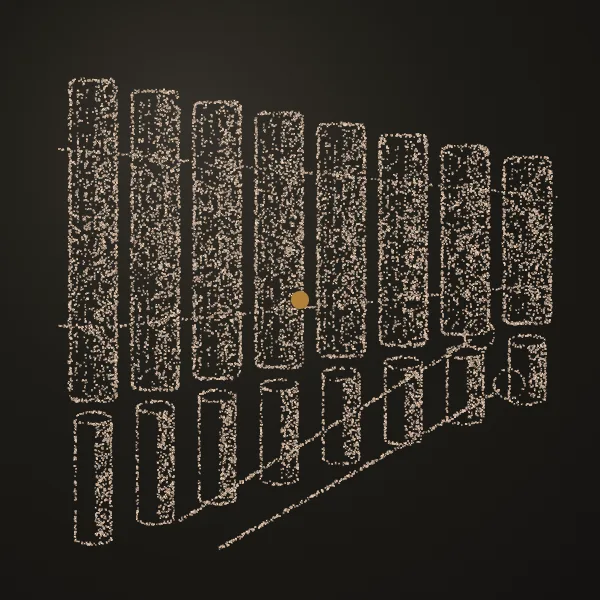
Yarn-wound mallets strike the bar near its middle. Softer mallets bring out less of the upper partials, harder ones give a bright, clicky attack.
Resonator Tuned bar
A plain bar of wood rings at 1, 2.76 and 5.40 times its note: a clang. The maker carves an arch under the middle of each bar until the first overtone sits exactly two octaves up (4×) and the next near 10×. The bar hangs on cords at its two nodes, the points that do not move.
Body Tuned tube
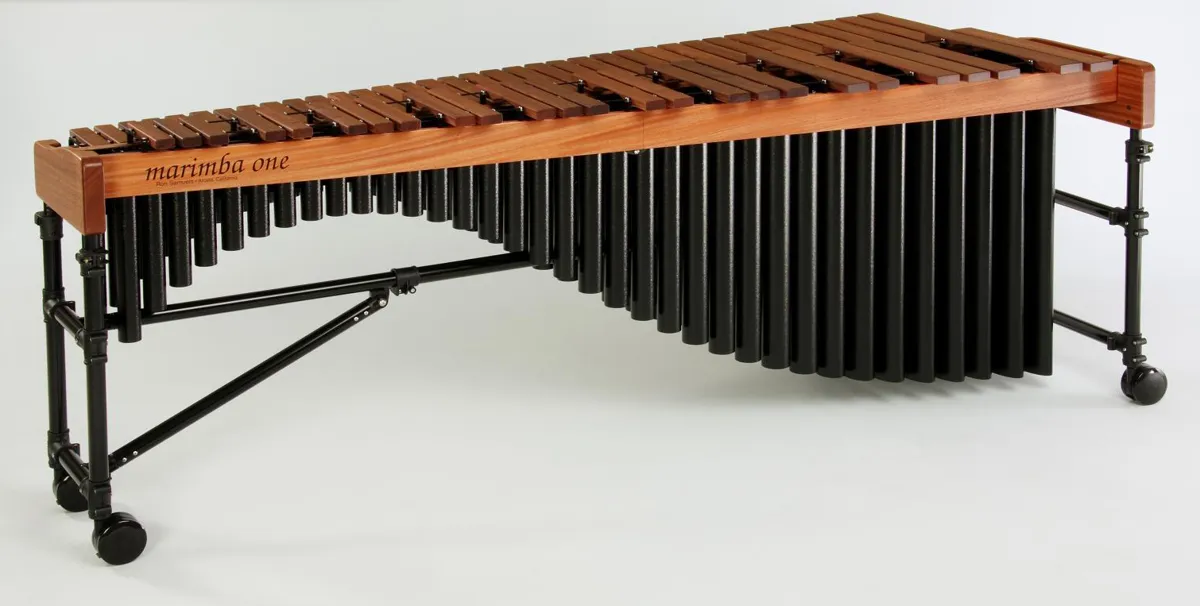
Under each bar hangs a tube closed at the bottom, a quarter of a wavelength long. It reinforces only the fundamental, so the note blooms and dies sooner. Traditional marimbas add a buzzing membrane over a hole in each resonator.
Where it comes from
Most scholars trace the marimba to African xylophones with gourd resonators, brought to the Americas by enslaved Africans; it took root in Guatemala and Chiapas in the 16th and 17th centuries. A fully chromatic Guatemalan marimba appeared around 1894, and the concert marimba was developed in the United States in the 1910s. Guatemala made the marimba its national instrument in 1978 and a national symbol in 1999.