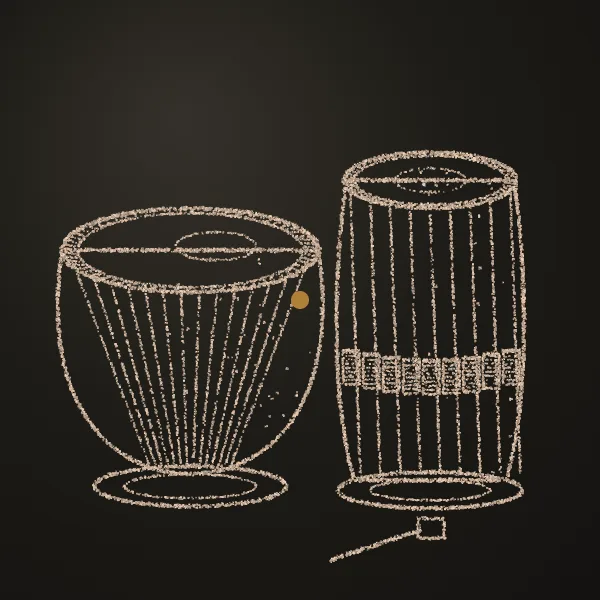
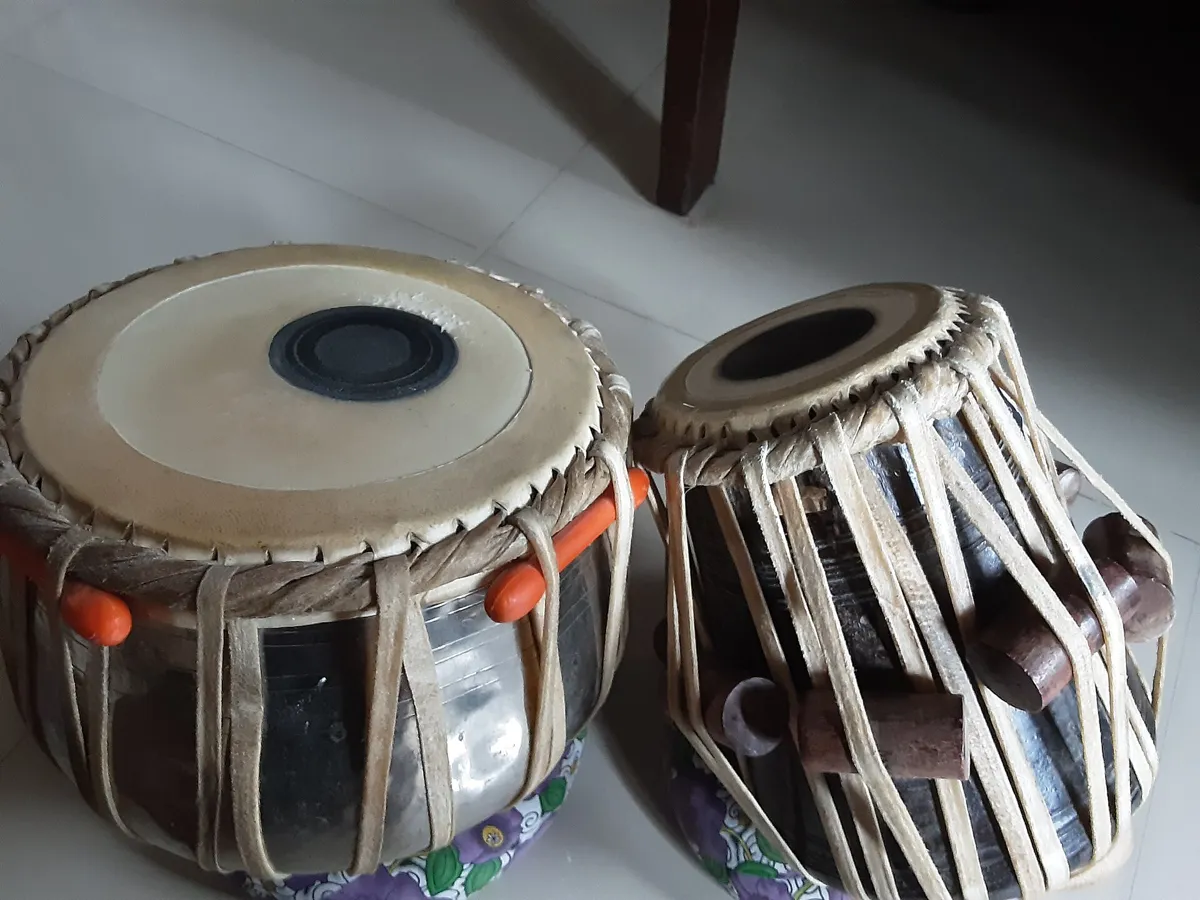
Fingers and the heel of the hand strike, press and slide on the heads. Each stroke has a spoken name, its bol ("dha", "na", "tin"), and whole compositions can be recited before they are played.
Resonator Loaded drumhead
The black syahi on each head is built up from many thin layers of paste and polished. Its weight, thickest in the middle, retunes the membrane's modes: C. V. Raman showed in 1920 that the loaded head gives a fundamental with near-harmonic overtones, unlike an ordinary drum.
Body Open air
The right-hand dayan is a wooden shell, tuned with a small hammer and with wooden blocks under the leather straps. The left-hand bayan is a big metal bowl, and pressing the heel of the hand into its head bends its pitch up while it rings: the tabla's talking glide.
Where it comes from
Paintings show the tabla clearly from about 1745, and it grew up in the 18th century in the courts and gharanas of Delhi, Lucknow and elsewhere. C. V. Raman, Nobel laureate in physics in 1930, studied the tabla and the mridangam and published the result in Nature in 1920 and in fuller form in 1934.