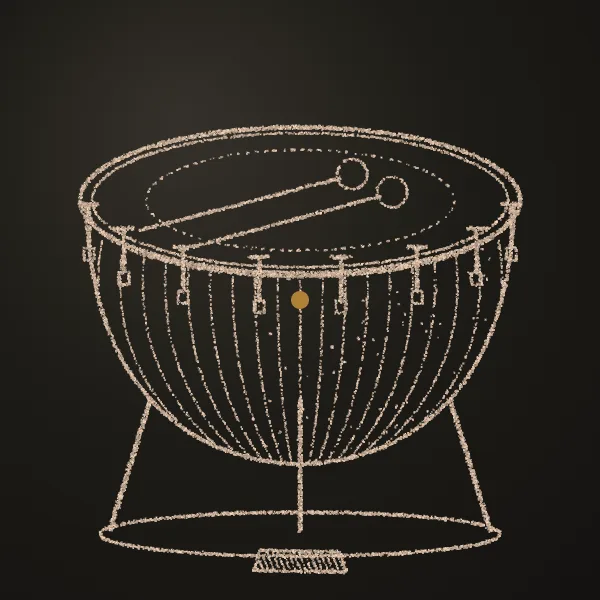
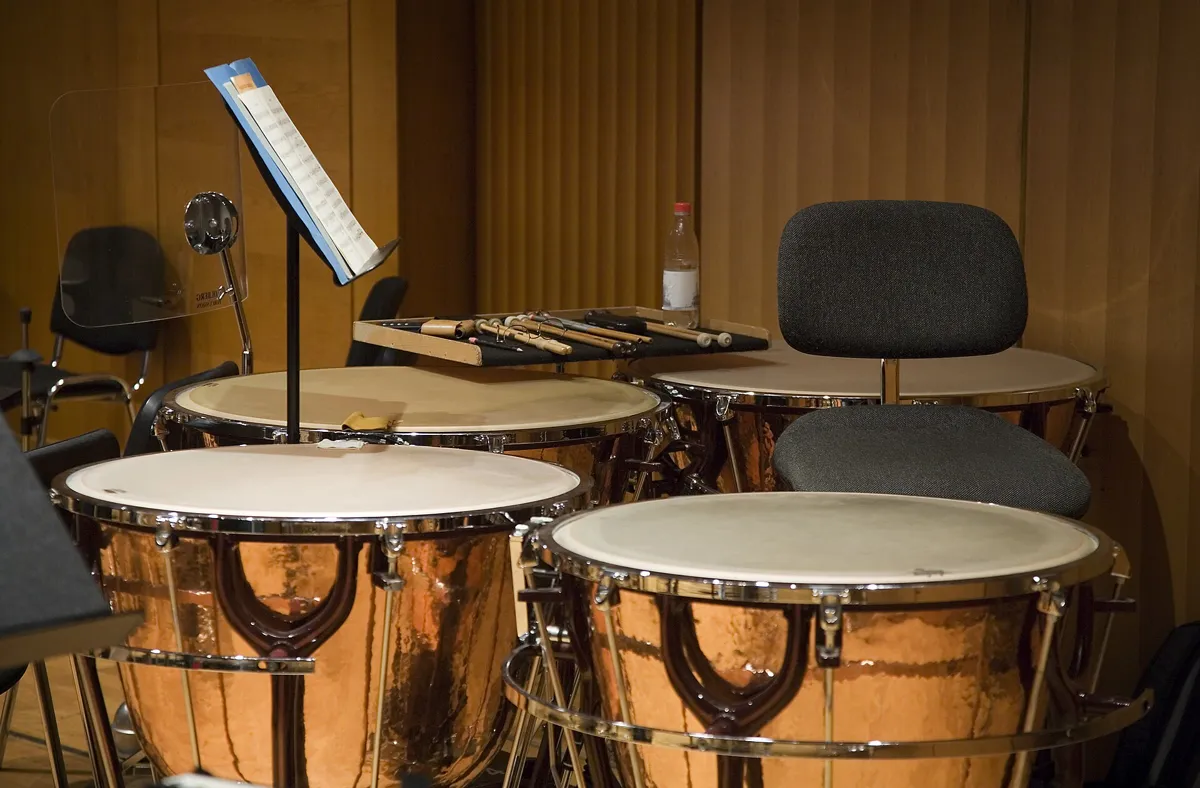
A felt mallet strikes the head about a quarter of the way in from the rim. The centre is avoided: it excites the dull, quickly dying lowest mode, a thud with no pitch.
Resonator Kettle drum
An ideal drumhead rings at 1, 1.59, 2.14, 2.30… times its lowest mode: a jumble, which is why most drums thump. On timpani the air above and inside the kettle loads the head and pulls its main modes to about 1 : 1.5 : 1.74 : 2 : 2.25 : 2.5. That is close to harmonics 2, 3, 4, 5 of a note that is not there, and the ear supplies it.
Body Open air
The kettle traps air under the head and decides how the head moves. The small hole in the bottom lets the pressure equalise.
Where it comes from
Kettledrums came to Europe from the Middle East and the Ottoman Empire, first as cavalry instruments played on horseback in pairs with trumpets. They joined the orchestra by the middle of the 17th century. Pedal timpani, built in Dresden in the 1870s, let the player retune while playing, even in glissandi.