← Whyarium no. 43 Excite / Resonate
Instruments · Winds

Pan flute

One pipe per note, each closed at the bottom, so each one sounds an octave lower than its length suggests.

Patch
Air jet → Stopped pipe → Open air
Class
H–S 421.112.2 · set of stopped end-blown flutes
From
China, the Andes, Greece, Romania and the Pacific
When
433 BC and earlier
01

Exciter

what pushes

Out
02

Resonator

what rings
In
Out
03

Body

what moves the air

In
Out
04

Sand plate

where the still lines are
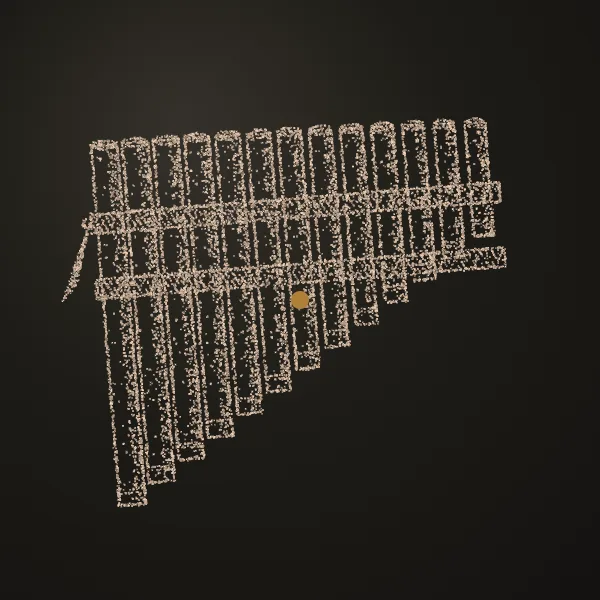
Pan flute drawn in sand on a dark metal plate
Note –– HzFigure –

In
Patch

Pan flute

One pipe per note, each closed at the bottom, so each one sounds an octave lower than its length suggests.

Exciter Air jet

The player blows across the open top of a pipe, exactly as across a bottle. The jet flips in and out of the pipe at the note's frequency, just as on the flute.

Resonator Stopped pipe

Each pipe is stopped at the bottom, often by the natural node of the cane. A stopped pipe sounds an octave lower than an open pipe of the same length and supports only odd harmonics, which gives the breathy, hollow tone. Players bend the pitch by tilting the instrument.

Body Open air

None. The open tops of the pipes radiate straight into the air.

Where it comes from

Panpipes were invented many times over. A set of 13 bamboo pipes (paixiao) was found in the tomb of Marquis Yi of Zeng in Hubei, China, sealed in 433 BC. The Andean siku splits its scale between two rows, played by two people who alternate notes to make one melody. The Romanian nai, curved and with 20 to 30 pipes, reached a world audience through Gheorghe Zamfir in the 1970s.
Pipes13 (Marquis Yi) to 30 (nai)
Pipeclosed at one end
Harmonicsodd only
Oldest dated set433 BC
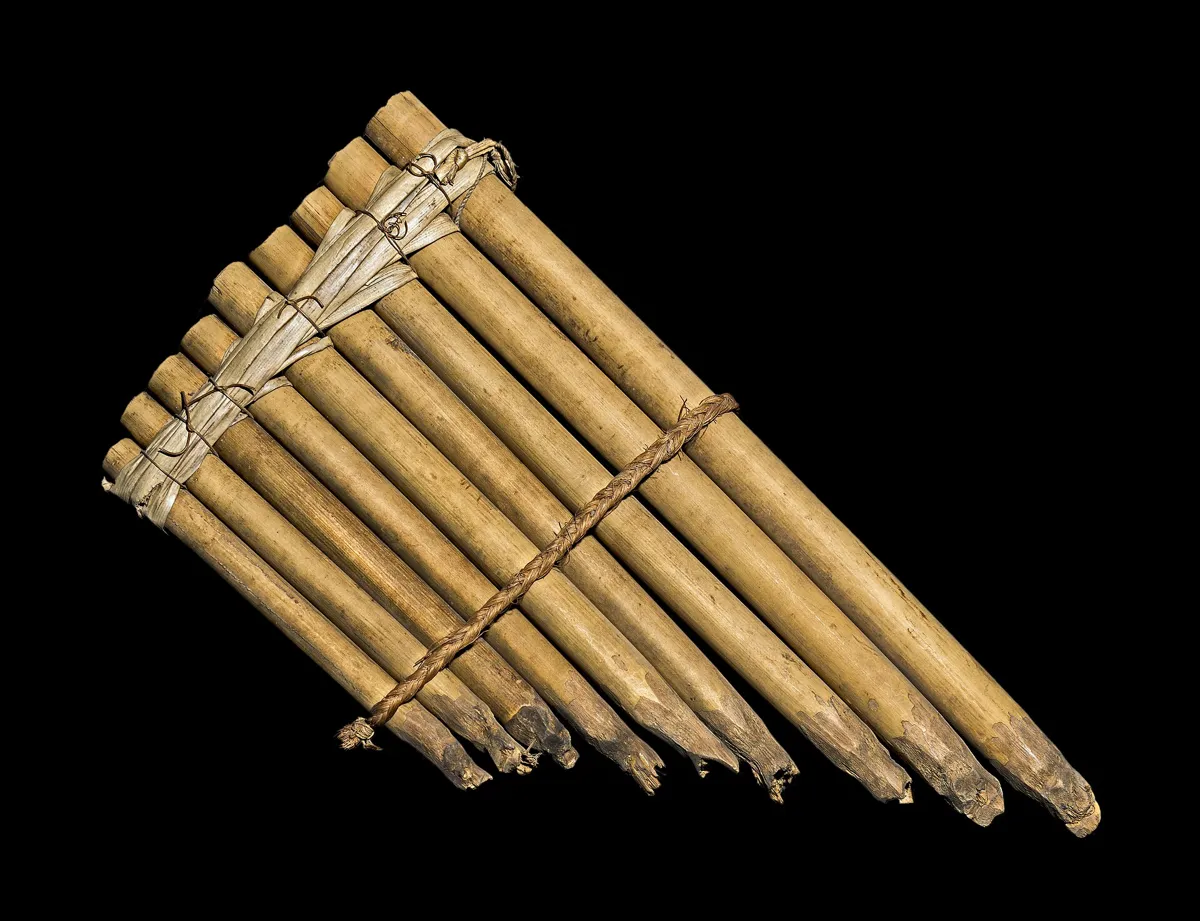
Photograph: Pan flute
Photo: Didier Descouens, Wikimedia Commons, CC BY-SA 4.0.

Worth knowing

  1. The Greek name, syrinx, comes from the myth of the nymph Syrinx, turned into reeds as she fled the god Pan, who cut them to make his pipes.
  2. Two siku players alternating notes is called hocketing.
  3. Zamfir's nai is on the soundtrack of the film Picnic at Hanging Rock (1975).
Often said

“The pan flute is a Greek instrument with one origin.”

Myth. Panpipes arose independently in many cultures; the Greek name is only one tradition.