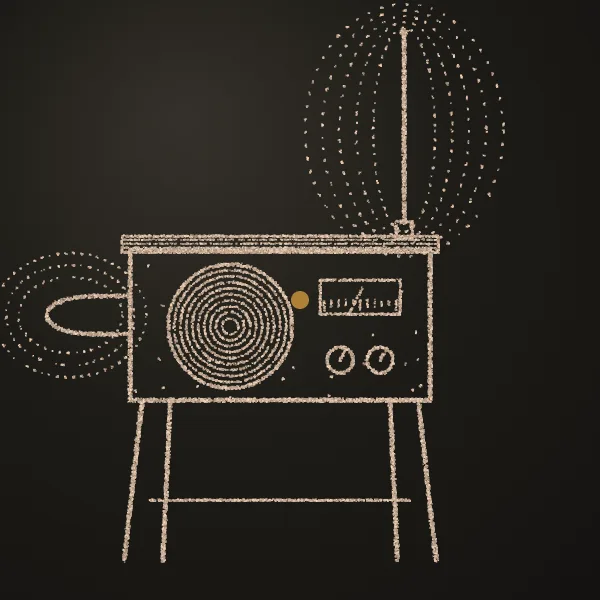
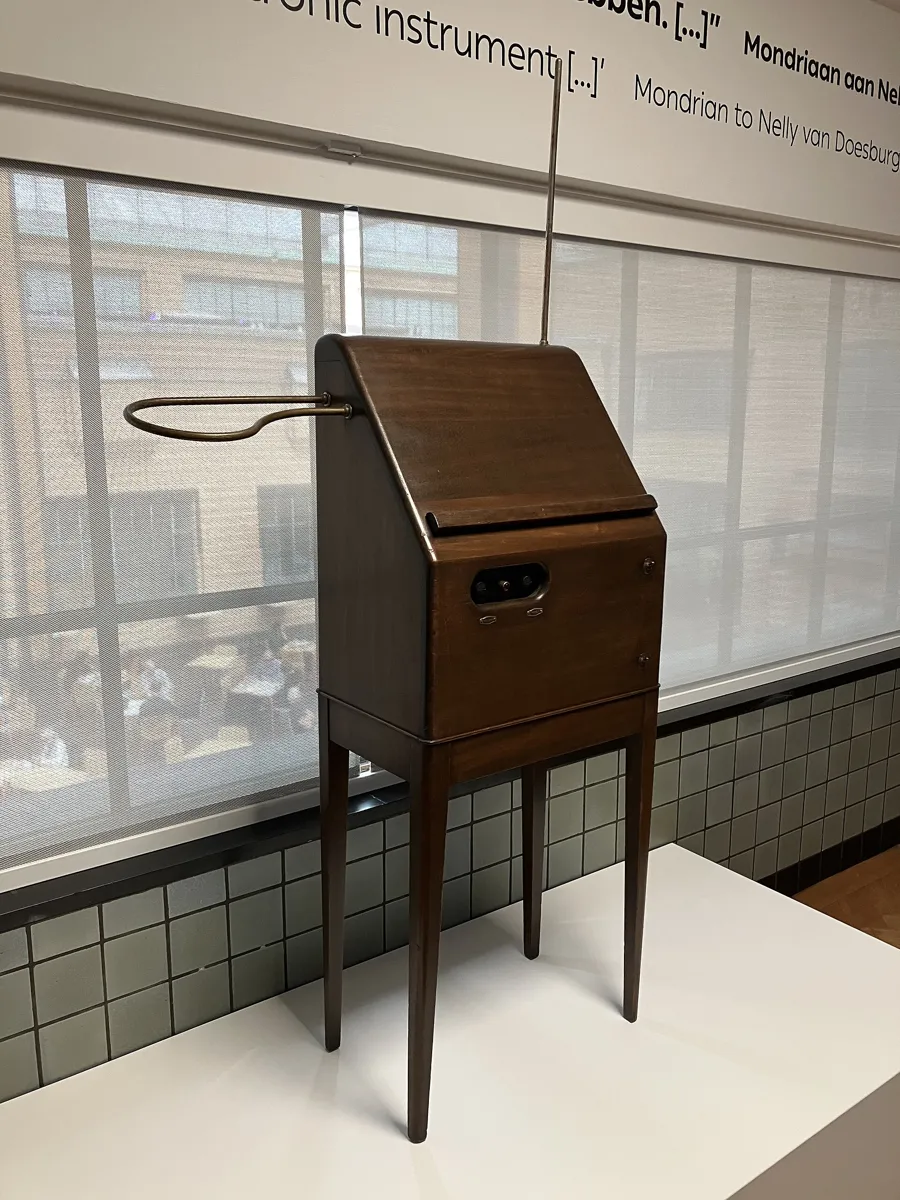
Two radio-frequency oscillators run side by side below 500 kHz, one fixed and one variable. The pitch antenna is part of the variable one, and a hand near it adds a few picofarads of capacitance and slows it down. Mixed together, the two give a difference tone in the audible range: the note.
Resonator Nothing (circuit)
Nothing rings. The note is the beat between two circuits, almost a pure sine, coloured a little by the circuit. A second antenna, the loop, works the same way on the volume.
Body Loudspeaker
A loudspeaker, often in the theremin's own cabinet. Since nothing in the instrument decays, a thereminist has to stop every note by moving a hand.
Where it comes from
Lev Termen (Leon Theremin) built it in Petrograd in October 1920, out of government research into proximity sensors, and patented it in the United States in 1928. RCA made about 500 theremins in 1929–30, launched just after the Wall Street crash, and they did not sell. Robert Moog built theremins as a schoolboy in the 1950s, before his synthesizers.
Clara Rockmore said a thereminist must "play the rests, as well as the notes".
Back in the Soviet Union, Theremin was held in a prison laboratory where he designed the "Great Seal bug", a listening device hidden in a gift to the US ambassador and found in 1952.
The right hand plays pitch at the vertical rod, the left hand plays volume at the loop.
Often said
“The Beach Boys' "Good Vibrations" uses a theremin.”
Myth. It is an Electro-Theremin, a slide-controlled oscillator played by Paul Tanner.